What to Do Upon Arriving in Canada as an Immigrant

Welcome to your new life! The first few days in Canada are exciting but filled with paperwork. This detailed checklist will guide you step-by-step to organize your arrival efficiently.
Step 1: The Port of Entry (Airport)
The official process begins as soon as you land in the country.
Present your documents: Show your passport and Confirmation of Permanent Residence (COPR) or your work/study permit to the CBSA officer.
Declare your belongings: Hand in the customs declaration form along with the list of items arriving later (Goods to Follow).
Mailing address: Provide a secure Canadian address so the government can mail your Permanent Resident card (PR Card).
Step 2: Obtain your Social Insurance Number (SIN)
The SIN is a confidential 9-digit number required to work, open bank accounts, and pay taxes.
Where to apply: Visit a physical Service Canada office to get it printed on the spot.
Online option: You can apply via the government portal, but processing takes several business days.
Security: Never share this number with anyone except your employer, your bank, and the Canada Revenue Agency (CRA).
Tip: Do not share your SIN with anyone except your employer and the bank.
Step 3: Open a Bank Account and Build Credit
You need a secure place for your money and a way to start building your Canadian credit score.
Newcomer packages: Major banks like RBC, TD, BMO, Scotiabank, and CIBC offer free banking for the first year to new immigrants.
Required documents: Bring your passport, COPR or permit, your SIN, and proof of address.
Credit card: Apply for a basic credit card immediately; using it responsibly is vital for renting an apartment or buying a car later.
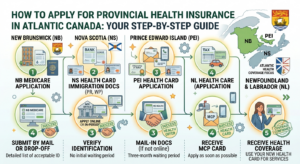
Step 4: Apply for Provincial Health Insurance
Healthcare in Canada is publicly funded, but it is managed individually by each province or territory.
Immediate registration: Apply for your provincial plan (e.g., OHIP in Ontario, MSP in BC, or AHCIP in Alberta) as soon as you have a permanent address.
Waiting periods: Some provinces have a waiting period of up to three months; consider buying private private health insurance to cover this initial gap.
Step 5: Get Connected and Find Housing
Setting up your communication channels will allow you to look for work and a permanent home.
Mobile phone: Get a local SIM card with budget-friendly plans from providers like Fido, Koodo, or Public Mobile.
Long-term housing: Use trusted platforms like atlantino.ca, Realtor.ca, Rentals.ca, or Kijiji to look for apartments, and never transfer money before viewing a property.
Essential Local Resources for Newcomers to Canada
Moving to a new country means finding your footing in a local community. Beyond the official government paperwork, getting involved with community networks will help you settle in, find a job, and make friends faster. Here is your step-by-step guide to connecting with your new Canadian neighborhood.
Step 6: Visit an Immigrant Settlement Agency
The Canadian government funds local organizations to help immigrants adapt to their new communities for free.
Find an agency: Use atlantino.ca directory to locate a settlement service provider near you or the Immigration, Refugees and Citizenship Canada (IRCC) website.
Get a settlement plan: A counselor will map out your specific needs, including language classes, housing support, and job training.
Language training: Register for the free Language Instruction for Newcomers to Canada (LINC) program to improve your English or French.
Step 7: Get a Public Library Card
Canadian public libraries are vibrant community hubs that offer much more than just books.
Free services: Access high-speed internet, computers, printing services, and quiet study spaces.
Newcomer programs: Most libraries host free English conversation circles, citizenship study groups, and resume-writing workshops.
What you need: Bring your ID and a proof of address (like a utility bill or lease agreement) to get your free library card.
Step 8: Connect with Mentorship and Networking Programs
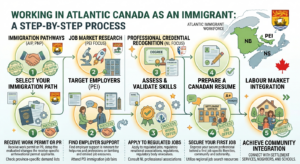
Finding a job in Canada often relies on networking and understanding the local workplace culture.
Immigrant employment councils: Organizations like TRIEC (Toronto), IEC-BC (Vancouver), or CRIEC (Calgary) match newcomers with professional mentors in their field.
Bridge training: Look for community college programs designed to bridge the gap between your international experience and Canadian licensing requirements.
Volunteer locally: Volunteering at a local food bank, community center, or charity is the fastest way to gain “Canadian experience” and build references.
Step 9: Register Children for School and Community Activities
If you are moving with family, getting your children settled into the community is a top priority.
School registration: Contact your local school board to register your children; they will need immunization records, birth certificates, and proof of your status in Canada.
Recreation centers: Cities operate municipal community centers offering low-cost sports leagues, swimming lessons, and fitness classes for all ages.
Subsidy programs: Ask your city’s recreation department about low-income subsidies to help cover the cost of children’s sports and summer camps.
Atlantino Directory
Find services near you in Atlantic Canada
From settlement agencies to local businesses, the Atlantino directory connects immigrants with everything they need to settle in.
Disclaimer
The information on this website is provided for general informational purposes only and may not reflect the most current developments in immigration law. None of the authors or contributors to atlantino.ca are lawyers, and we do not provide legal advice.
Use of AI: We use AI tools to assist in generating content and images. While we make reasonable efforts to review materials, we cannot guarantee their accuracy or compliance with current regulations.