Everything you need to know when you arrive in Canada.
Navigating the Canadian immigration system can feel like learning a completely new language. This guide breaks down the core pathways—Work Permits, the Atlantic Immigration Program (AIP), and Express Entry—with real pros, cons, and hidden rules to help you make informed decisions.
1. Work Permits: Your Temporary Entry Footprint
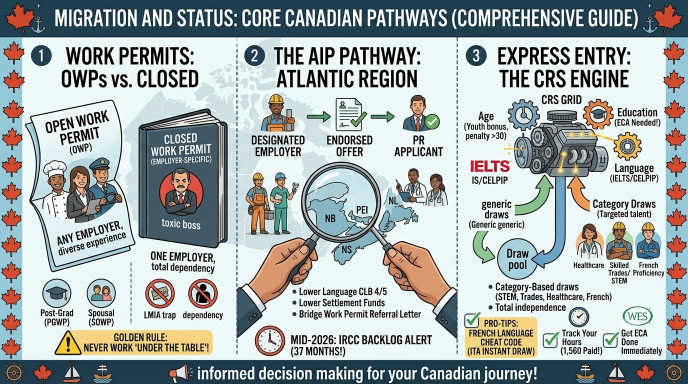
Before you can become a Permanent Resident (PR), you will often start with a Temporary Work Permit. These are divided into two massive categories and mixing them up is a common mistake.
Open Work Permits (OWP) vs. Closed Work Permits (Employer-Specific)
The Reality & Rules
The LMIA Trap: To give you a closed work permit, an employer usually needs a Positive Labour Market Impact Assessment (LMIA) to prove no Canadian could do the job. The application fee is $1,000 CAD (paid by the employer), and processing can take months.
The Golden Rule: Never work “under the table” or outside your permit conditions. Even a week of unauthorized work can get you banned or completely ruin your future PR applications.
2. The Atlantic Immigration Program (AIP)
If you land in or are moving to the Atlantic provinces (New Brunswick, Nova Scotia, Prince Edward Island, or Newfoundland & Labrador), the AIP is one of the most powerful tools available. It is a regional pathway designed to fill local job shortages.
How It Works
AIP is an employer-driven program. This means you cannot simply apply on your own; an employer must first be officially “Designated” by their province, and then they must “Endorse” your specific job offer.
The Pros:
Lower Language Hurdles: Unlike standard federal programs that require high scores, AIP accepts lower language benchmarks (CLB 4 for TEER 4 jobs, CLB 5 for TEER 0, 1, 2, 3).
Lower Proof of Funds: If you are already living and working in Canada with a valid work permit, you are exempt from showing settlement funds.
The Work Permit Bridge: Once the province endorses you, they will give you a Work Permit Referral Letter. This allows you to apply for a temporary work permit to stay and work while IRCC processes your PR.
The Cons:
The Current Processing Backlog: As of mid-2026, official IRCC data shows AIP processing times have ballooned significantly stretching up to 37 months due to massive application volumes. It is no longer a “fast” route.
Zero Self-Employment: Any work experience gained through self-employment or freelancing counts as exactly zero hours toward AIP eligibility.
Employer Commitment: Your job offer must be full-time, non-seasonal, and usually for at least 1 year (or permanent for TEER 4). If the company downsizes before your endorsement, you have to start over with a new designated employer.
3. Express Entry: The Canadian immigration system points engine
Express Entry is Canada’s flagship online system for managing economic immigration applications. It ranks candidates using the Comprehensive Ranking System (CRS), a points-based grid measuring age, education, language skills, and work experience.
The Three Streams (Transitioning to a Unified System)
Historically, Express Entry managed three separate programs: the Federal Skilled Worker Program (FSWP) for people abroad, the Canadian Experience Class (CEC) for those with 1 year of Canadian experience, and the Federal Skilled Trades Program (FSTP).
2026 Core Update: IRCC has systematically moved away from broad, generic draws and is operating aggressively through Category-Based Selection. They target specific talent pools directly (such as Healthcare, Skilled Trades/Construction, STEM, and French-language proficiency).
The Pros:
True Speed: If you receive an Invitation to Apply (ITA), applications are processed entirely online, typically within 6 months—massively faster than standard regional pathways.
Total Independence: You do not technically need a Canadian job offer or an employer sponsor to enter the pool or get invited if your base human capital scores are high enough.
The Cons:
The Age Penalty: The CRS system favors youth. You get maximum points for age between 20 and 29. The moment you turn 30, you begin losing points every single year on your birthday.
Fierce Competition: General CRS cutoff scores are incredibly high. For candidates without Canadian education, French fluency, or a provincial nomination, it can be almost impossible to get drawn out of the standard pool.
Pro-Tips & Rules Immigrants Wish They Knew Earlier
Get Your ECA Done Immediately: If you studied outside of Canada, your degree means nothing to IRCC until it is evaluated via an Educational Credential Assessment (ECA) through organizations like WES. Do this before you even pack your bags; it takes weeks to process.
The French Language Cheat Code: French is Canada’s immigration golden ticket right now. Even a moderate level of French (CLB 7) can bypass sky-high CRS point requirements through targeted French-language draws, instantly granting you an ITA.
Track Your Hours, Not Just Your Calendar: To qualify for programs like the CEC or AIP, 1 year of work experience means exactly 1,560 hours of paid work. If you work 50 hours a week, you cannot claim your year early; IRCC limits the calculation to a maximum of 30 hours per week. Conversely, part-time work counts, but it takes longer to accumulate those 1,560 hours.
Save For Official Fees: Immigration is expensive. Between language tests (IELTS/CELPIP), ECA fees, biometrics ($85), and IRCC permanent residence processing fees (which sit at over $1,500 CAD per adult), you need a dedicated financial buffer just to file the paperwork.
Join thousands of newcomers thriving in Atlantic Canada! Sign up for the official Atlantino updates and get exclusive access to local housing alerts, job directories, and community news. Subscribe today and build your new Canadian future with us!