
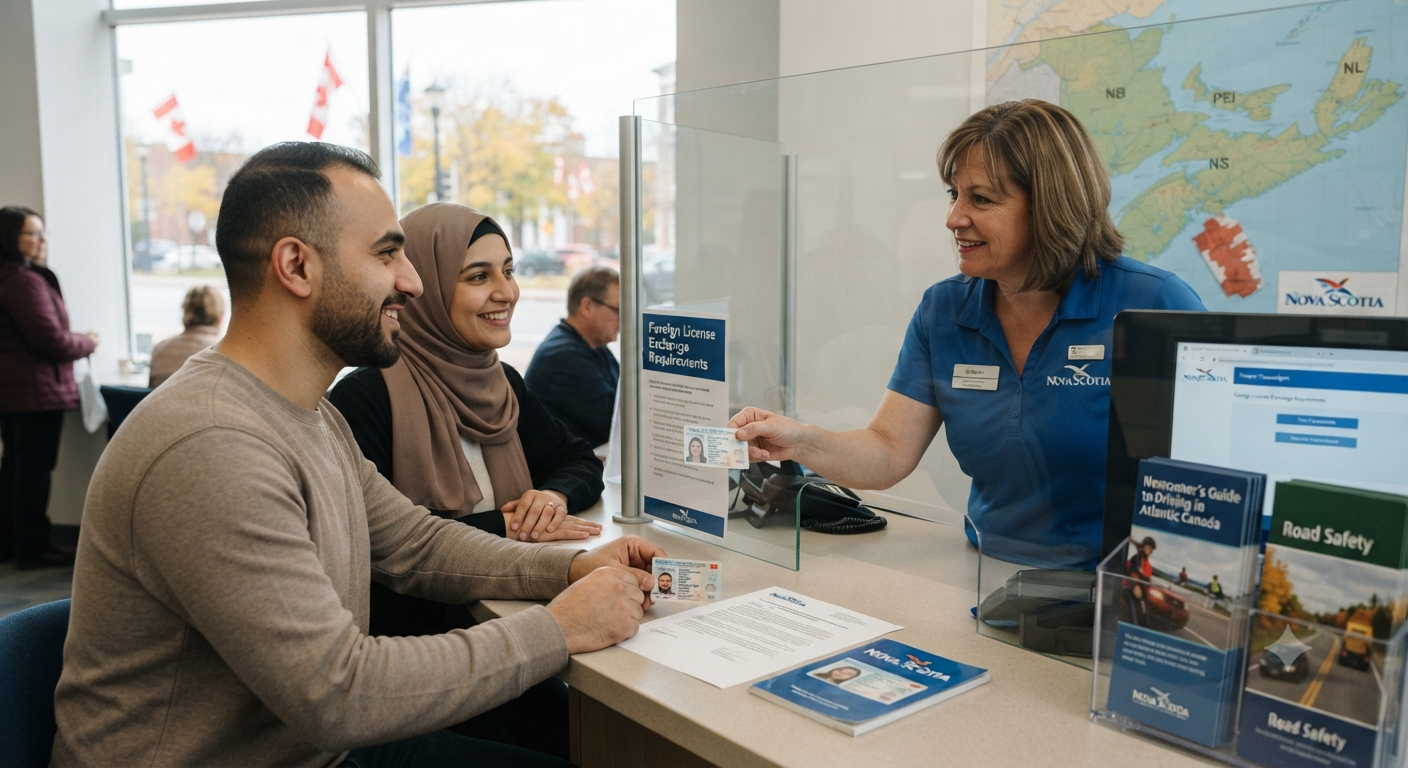
Getting behind the wheel legally is one of those settlement tasks that catches a lot of newcomers off guard. You assume your existing license will just work, or that exchanging it is a quick form at a counter — then you find out the process depends heavily on which country issued your license and which Atlantic province you've landed in. Here's how it actually works.
You Can Usually Drive for a While on Your Existing License
Across Nova Scotia, New Brunswick, PEI, and Newfoundland and Labrador, new residents typically get a grace period — commonly up to 180 days — during which a valid foreign license lets you drive without exchanging anything first. That window buys you time to get settled before dealing with paperwork, but don't let it lapse: driving on an expired grace period, or on a license that's expired, isn't allowed.
The Exchange Process Depends on Where You're From
This is the part that surprises people most. Provincial motor vehicle authorities maintain lists of countries with "reciprocal" driving agreements — usually places with driver training and testing standards considered comparable to Canada's (common examples include the UK, Germany, France, Australia, Japan, and South Korea, though exact lists vary by province and change over time).
If your country and license class are on the list, you generally just need to pass a vision test, provide proof of identity, and pay a fee to swap your license for a local one — no knowledge or road test required.
If your country isn't on the list, expect full testing: a written knowledge test on local road rules and signage, a vision test, and a road test, in that order. You'll usually drive on a learner or restricted license in the meantime.
Since the exact reciprocal country list differs by province and gets updated, check your specific province's motor vehicle registry page directly before assuming which path applies to you — don't rely on what worked for a friend who landed in a different province.
What You'll Need to Bring
Regardless of which path applies, plan to bring:
Your current, valid driver's license (not expired or suspended)
A certified English or French translation if your license isn't already in one of those languages — this usually has to come from an approved translator, immigrant settlement agency, or your country's consulate; a standard International Driving Permit does not count as a translation
Additional government-issued proof of identity
Payment for the applicable licensing fee
If you're doing full testing, get a copy of the provincial driver's handbook first (most are free to download) — the knowledge test draws directly from it, and local road rules often differ from what you're used to, even if you've driven for years elsewhere.
Common Trip-Ups
A few things newcomers frequently miss:
Letting the grace period expire before starting the exchange, which can mean losing your ability to drive legally until the process is complete
Assuming a license class matches automatically — a foreign motorcycle or commercial license doesn't always convert to the equivalent local class without separate testing
Skipping the translation requirement because the license "looks readable" — offices will not proceed without a certified translation if the license isn't in English or French
Not booking road test appointments early enough — in-demand slots can book out for weeks in busier service centers, so if you know you'll need one, book as soon as you're eligible
Start the Process Early
Whichever province you're settling in, the exchange is rarely instant — between booking appointments, testing, and waiting for the physical card to arrive by mail, it can take several weeks from your first visit to holding a local license. Start well before your grace period runs out, especially if you'll need a car for work or childcare logistics.
Not sure what else needs to be on your settlement checklist alongside your driver's license? Atlantino's interactive settlement guide walks through the practical steps newcomers need to handle in their first months in Atlantic Canada, in the order that actually makes sense.